
Can you be Silently Hacked through an ad without clicking anything
Yes. In October 2026, researchers published technical evidence confirming that commercial spyware can be delivered through targeted online ads without the victim clicking on anything.

For years, we’ve been told that cyberattacks start with a user making a mistake: clicking a suspicious link, opening a malicious email attachment, or installing a dangerous app.
But what happens when an attack no longer requires any action from the user?
On October 15, 2026, researchers at Citizen Lab, a research laboratory at the University of Toronto, published an investigation documenting technical evidence of commercial spyware being delivered through targeted online ads without any interaction from the victim. The technique was named AdFection.
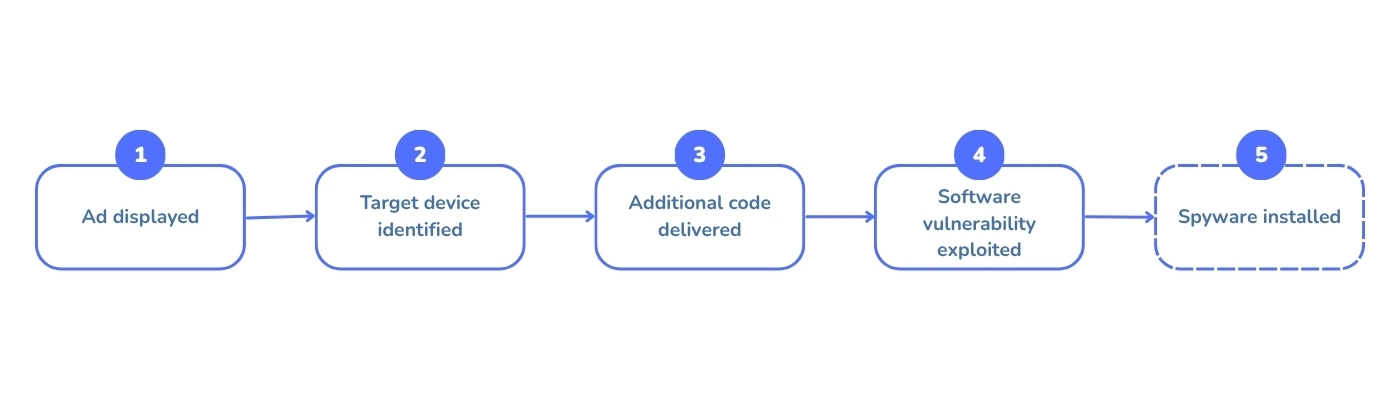
The investigation reveals how digital advertising infrastructure, normally used to deliver relevant ads, was repurposed to distribute surveillance software. In the documented cases, simply displaying an ad on a targeted device could trigger the attack chain.
How Does AdFection Work?
To understand this type of attack, we first need to look at how modern online advertising works.
Ads we see on websites and in apps aren’t always static images. Some are delivered through HTML elements and JavaScript code that can request additional content from external servers when an ad is displayed.
That’s not a vulnerability in itself. The problem arises when this infrastructure is used to deliver malicious code to specific devices.
1. The Ad Auction
When you open a website or app, the ad you see is often selected through an automated process called Real-Time Bidding (RTB).
In a nutshell, multiple advertisers can bid within milliseconds for the opportunity to show an ad to a particular user. The system may use information such as advertising IDs, approximate location, device type, and other available signals to determine which ad to serve.
Normally, this mechanism is used to deliver personalized advertising. However, the same ability to select specific devices can be exploited to identify and target people of interest.
2. The Ad Becomes a Communication Channel to the Attacker’s Server
According to the Citizen Lab investigation, the company Discover-Tech used its own advertising infrastructure, including a platform called Controlium, to facilitate profiling and spyware delivery operations.
Some of the ads examined contained elements that caused a device to contact servers controlled by this infrastructure. The server could evaluate information such as the device’s IP address and publicly available identifiers to determine whether it matched the targeting criteria.
If the device wasn’t a target, the server could simply refrain from returning any additional executable code. If the device met the criteria, the server could deliver JavaScript to trigger the next stage of the attack.
3. Spyware Installation
In the next stage, code delivered through the advertising infrastructure could request additional components, including an exploit designed to take advantage of a software vulnerability.
If the exploit succeeds, the attacker may gain the ability to execute code on the device and install spyware. The outcome depends on the vulnerabilities exploited and the security protections already in place.
How Can You Protect Yourself?
There’s no single measure that can eliminate the risk entirely, especially when dealing with sophisticated attacks. However, a few steps can help reduce your exposure.
1. Keep your operating system and browser up to date.
Security updates can patch vulnerabilities that exploits rely on. Enable automatic updates whenever possible.
2. Use a reputable ad blocker.
An ad blocker can reduce your exposure to malicious ads, although its effectiveness depends on your browser, the app you’re using, and how the content is delivered.
3. Choose a browser with strong security protections.
Look for features such as Safe Browsing, process isolation, and exploit protection. These safeguards can help reduce the risk of malicious content compromising your device.
Conclusion
AdFection shows that online advertising can be more than a privacy concern or a source of intrusive ads. Under certain conditions, it can become a delivery mechanism for sophisticated surveillance tools.
It’s also a reminder that hacking techniques continue to evolve. Cyberattacks don’t always require a careless click. Sometimes, simply viewing an ad may be enough to put a targeted device at risk.