
The “Duck” test is dead: Inside the New OpenAI “Poisoned Tenant” attacks
Attackers are bypassing traditional email security by leveraging official OpenAI invitation functions. By setting up unauthorized organizations that mimic corporate naming conventions, they trick employees into joining a compromised workspace. Once inside, the attacker quietly harvests sensitive data from daily prompts and API interactions, turning the platform into a covert intelligence feed.
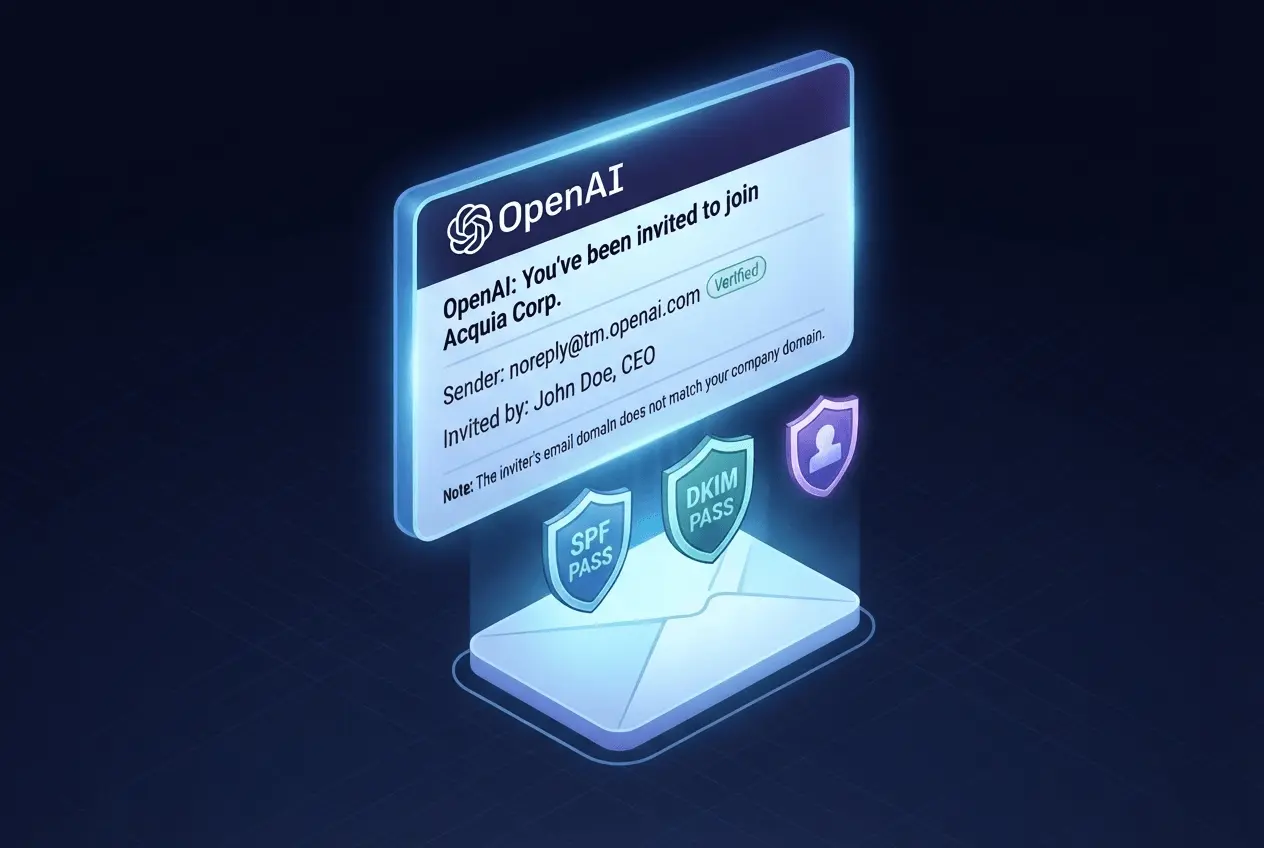
We probably all know the long-standing saying: “If it looks like a duck, swims like a duck, and quacks like a duck, then it probably is a duck.” Well, that logic doesn’t hold up anymore in cybersecurity. Lately, we are seeing a concerning rise in “Poisoned Tenant” attacks specifically targeting cybersecurity and technology companies. Thus, what looks like a completely authentic email from OpenAI, easily passes all the standard security checks, is in fact a meticulously orchestrated trap.
How the Attack Works
- Attackers create a fake OpenAI organization, name it after the target company, attach a credit card (likely stolen) to cover the billing, and then invite specific employees.
- Inside the fake workspace, the attacker configures an account to impersonate a high-level figure (such as the company’s CEO) and grants every invited employee full Owner administrative privileges.
- Employees receive the invitation emails from OpenAI’s official notification address (noreply@tm.openai.com). Since the platform itself sends the email, it passes all the standard SPF and DKIM checks. On the surface, it looks entirely authentic; meaning, much like a duck, it walks and quacks just like the real thing.
The only hint of trouble is a small warning note buried as a single line in an otherwise normal notification.
“The inviter’s email domain does not match your company domain.” - If an employee does accept the invite, nothing triggers any immediate suspicion. Acceptance requires zero credential entry or account creation. Clicking the link, even in a separate browser profile, instantly adds the user to the attacker’s organization.
Hence by eliminating login prompts, paywalls, and suspicious sender addresses, the attackers build an environment that feels completely safe from the very first click.
What the attacker gains
Investing time and resources into spinning up a fake OpenAI organization, attaching billing details, and executing targeted research requires a deliberate effort. Attackers do not go to these lengths without a serious return on investment. So, what is the ultimate goal?
To understand, look at how enterprise users treat AI platforms. While not every interaction involves sensitive data, a significant portion of daily engineering, research, and administrative work relies on pasting internal code snippets, documentation, and technical queries directly into prompts.
If an employee assumes the workspace is legitimate and conducts normal work inside it, the attacker, who already established an administrator position from the beginning, now gains a live feed of all prompt activity, usage logs, and API interactions, turning a fake workspace into a covert intelligence feed.
Defense measures and Mitigations strategies
As those types of attacks leverage legitimate infrastructure and bypass traditional email filtering barriers, defending against them requires a multi-layer approach focused on visibility and policy enforcement.
- Monitor external domain invitations: IT security teams should configure cloud access security brokers (CASB) or identity providers to flag SaaS tenant invitations originating from outside the corporate domain, treating external administrator grants as high-risk anomalies.
- Enforce SaaS Governance and Shadow IT Discovery: Organizations must actively audit authorized versus unauthorized AI platform tenants, restricting employees from registering company-associated workspaces without explicit IT approval.
- Educate Teams on the “Trust Trap”: Security awareness training must evolve beyond spotting malicious links or bad grammar, teaching personnel to closely inspect domain mismatch warnings even when notifications arrive from trusted platforms like OpenAI.
Conclusion
The poisoned tenant attacks represent a fundamental evolution in social engineering. By shifting away from traditional phishing emails sent from compromised or lookalike domains, attackers now weaponize the legitimate infrastructure of trusted enterprises SaaS platforms.
When a fake workspace bears a familiar company name, carries valid billing credentials, and arrives via official notification channels, traditional security instincts fail.
Stopping these advanced campaigns requires moving beyond basic email filters. Security teams must enforce strict SaaS governance, monitor external administrative grants, and train personnel to recognize that trusted platforms can easily host untrusted environments. As modern workflows increasingly rely on cloud-based tools, securing the enterprise requires defending not just the network premier, but the very ecosystem we trust to get work done.
Want to stay up to date with everything new in IT?
Stay informed and discover the latest analyses, trends, and practical tips written by our experts. Visit our blog to better understand current technological challenges and how you can prevent them.